

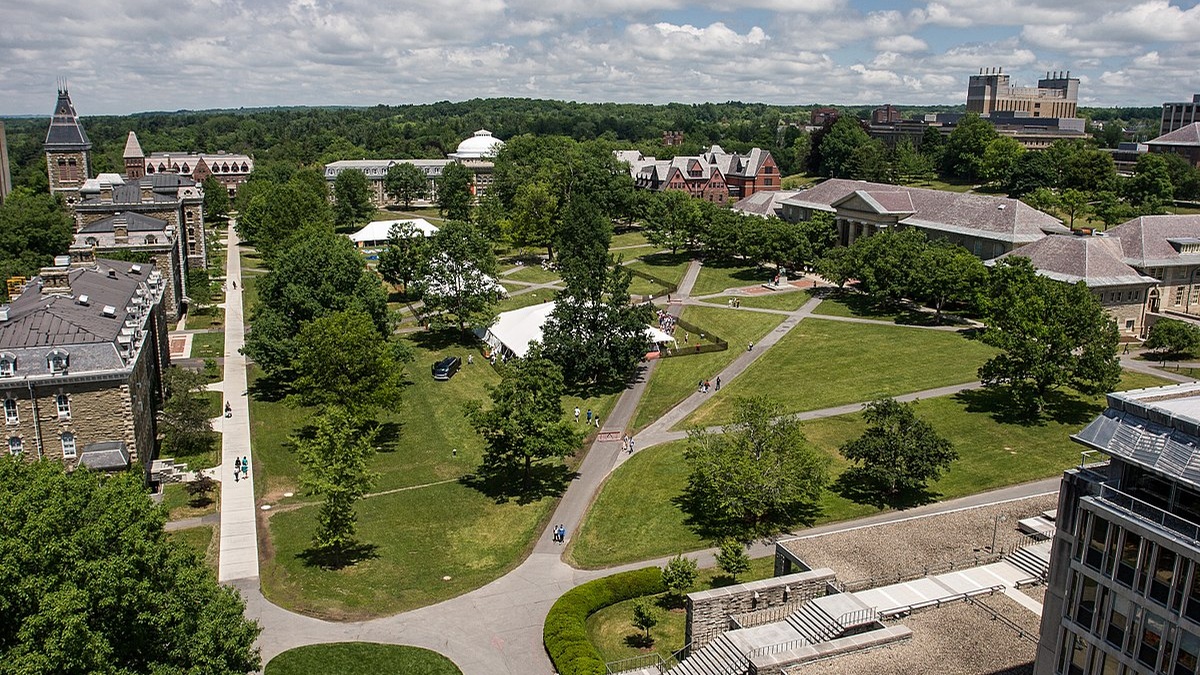
Former Ohio Gov. John Kasich told a Cornell audience Thursday that people in rural communities and inner cities often share the same frustration: They feel powerless and wonder why they can’t get ahead. He pointed to Ohio’s Medicaid expansion and response to opioid overdoses as examples of how he approached those concerns as governor.
The public conversation with Peter Loewen, Cornell’s Harold Tanner Dean of Arts and Sciences, opened a yearlong effort to study what divides rural and urban communities and where they can find common ground. The Nov. 19 event took place in Rhodes-Rawlings Auditorium in Klarman Hall, according to the Cornell Chronicle’s account of the discussion.

What Kasich did in Ohio
Kasich called health care and education the biggest issues facing rural communities. He cited his decision to expand Medicaid as one way his administration addressed needs in urban areas. When asked how he worked across the rural-urban divide, he recalled meeting women whose children had died of opioid overdoses.
Kasich said his administration set rules for dispensing drugs that shut down pill mills. He also said he changed oversight so the state medical board would hold doctors accountable and the pharmacy board would do the same for pharmacists over their roles in the opioid crisis.
On jobs, Kasich said Ohio created a nonprofit devoted to economic development. He credited that change with speeding up the state’s work and helping attract technology investment.
A student asks how officials can listen
During the question period, an art history student from a rural area asked what public officials could do to better understand communities like hers. Kasich said problems such as hunger can feel abstract to people far away. He urged rural public officials to talk more plainly about what people in their communities are going through.
Kasich also blamed President Donald Trump for Republican losses in the midterms and criticized party members who, in his view, put their political futures ahead of what they believed was right.
Cornell begins a year of research
Before the public talk, faculty and senior administrators from Cornell and other universities met to examine why rural and urban communities are divided, how far those divisions reach and what might narrow them.
Cornell’s College of Arts and Sciences, College of Agriculture and Life Sciences and Cornell Center on Democracy are leading the yearlong effort. Loewen said the initiative would draw on expertise at Cornell and elsewhere.
Original preview published Nov. 15
Former Ohio Gov. John Kasich will visit Cornell University on Nov. 19 for a public conversation about bridging divisions between urban and rural communities, helping launch a yearlong university initiative.
The free event runs from 5:30 to 6:30 p.m., according to Cornell’s current event calendar. It will take place in Rhodes-Rawlings Auditorium, room KG70 in Klarman Hall, at 232 Feeney Way in Ithaca. Registration is required.
Peter Loewen, Cornell’s Harold Tanner Dean of Arts and Sciences, will moderate the discussion with Kasich about how the United States can reduce urban-rural polarization. The keynote is open to the public, while the associated academic workshop is closed.
Workshop begins a broader initiative
Before the public conversation, scholars from U.S. universities and think tanks will gather to examine the forces separating urban and rural communities, according to Cornell Chronicle’s report.
Their subjects include economic change and rural life; political representation and the geography of power; culture, information and shared civic life; and the responsibilities of a land-grant university to democracy.
Loewen said the effort will examine the causes, consequences and extent of urban-rural divisions, possible solutions and the role universities can play in narrowing those gaps. The workshop is expected to produce a white paper setting an agenda for a multiyear project.
The workshop opens a yearlong initiative involving Cornell’s College of Arts and Sciences, College of Agriculture and Life Sciences and Cornell Center on Democracy.
Kasich served as Ohio governor from 2011 to 2019 and sought the Republican presidential nomination in 2016. His congressional service included chairing the House Budget Committee and serving on the Armed Services Committee.
Attendees can find registration information through the event calendar. Cornell’s announcement specifies a strict no-bag policy for the evening event.
Make FL1 part of your day.
Local reporting. Useful updates. More ways to stay close to your community.
Go ad-free
Support independent local reporting and enjoy FL1 without display ads.
$4.99 / month
Become a member →Cancel anytime. Third-party media players may contain ads.Get the daily briefing
Start your morning with the headlines that matter across the Finger Lakes.
Find more FL1 on Google
Choose FingerLakes1.com as a preferred source to see more of our reporting in your Google news results.

FingerLakes1.com is the region’s leading all-digital news publication. The company was founded in 1998 and has been keeping residents informed for more than two decades. Have a lead? Send it to news@fingerlakes1.com.